Unitree’s new H2-X Kung Fu Legend Guardian combines impressive physical demonstrations with a vision of robotic security. However, the company has yet to confirm its specifications, pricing or plans to make the machine commercially available.
Unitree, one of the leading names in humanoid robotics, has unveiled a new robot designed to showcase physical strength, agility and potential security applications.
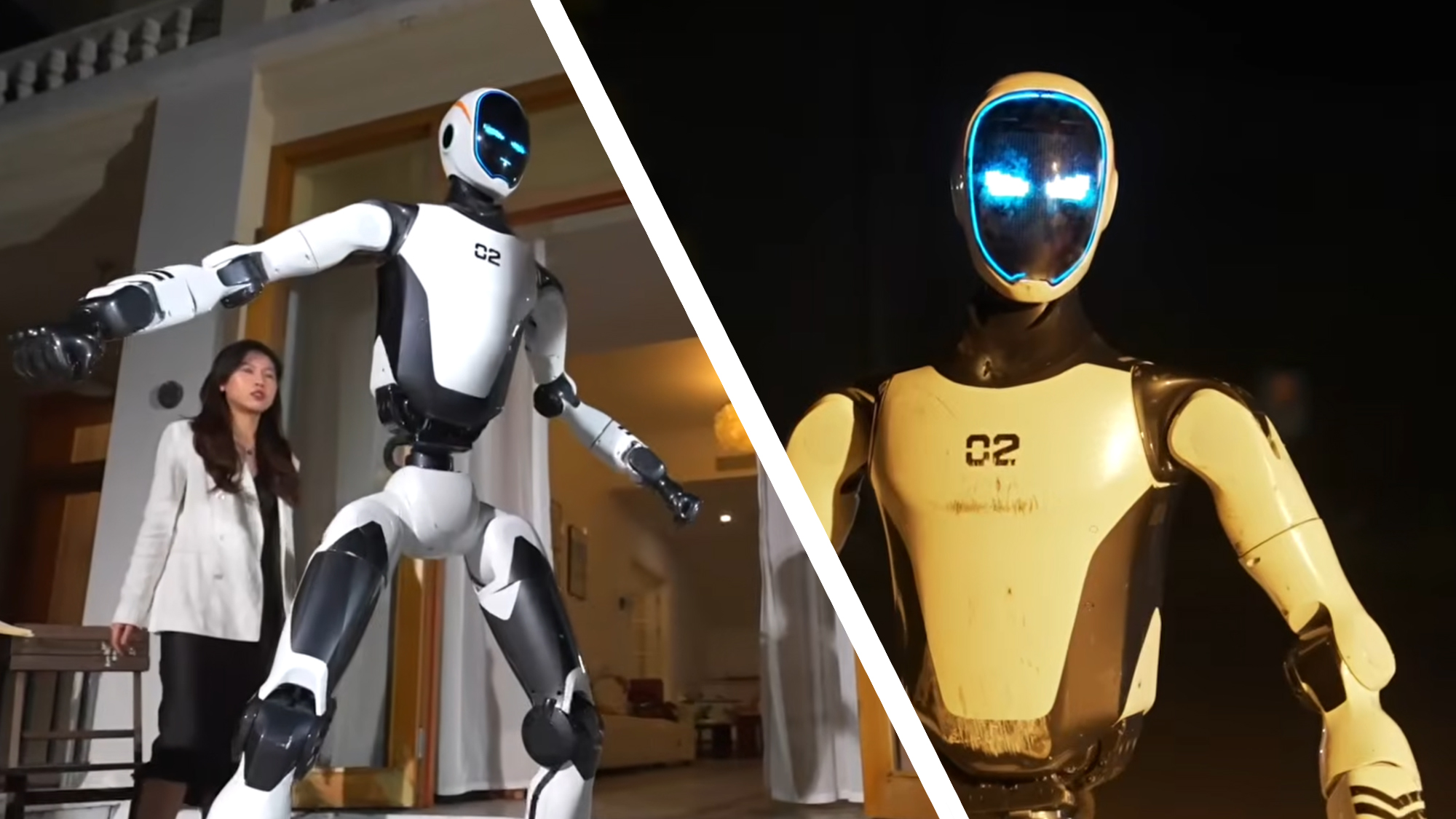
Called the H2-X Kung Fu Legend Guardian, the humanoid robot appears in a promotional video performing martial arts-style moves, protecting a person from a simulated robbery and lifting a car to free someone trapped underneath.
Despite the dramatic presentation, the H2-X remains more of a technology demonstration than a ready-to-buy personal security robot.
A humanoid robot built for strength and agility
Unitree’s teaser video, released on X and YouTube, opens with the H2-X delivering punches and knee strikes to cars in a scrapyard. The scenes resemble a fighting-game bonus round, emphasizing the machine’s apparent power and coordination.
The demonstration then shifts to more practical scenarios, presenting the robot as a potential personal bodyguard. In one sequence, it moves in front of its owner during a simulated robbery. Another shows it lifting a vehicle to release a person trapped beneath it.
These scenarios suggest that Unitree wants to demonstrate more than martial arts-inspired movements. The company is also highlighting how humanoid robots might eventually assist with security and emergency-response tasks.
However, the video does not establish how effectively the robot would perform in real-world situations. Its ability to respond safely and reliably to unpredictable threats remains an important unanswered question.
Eight hours of operation and impressive jumping ability
Unitree has revealed relatively few technical details about the H2-X.
The company says the robot can jump from platforms approximately four metres high and remain standing for around eight hours between charges. It has not provided a comprehensive specification sheet explaining the battery capacity, operating conditions or how long the robot could perform demanding tasks continuously.
For context, Unitree’s existing H2 humanoid robot stands approximately 1.8 metres tall. That model offers an optional Nvidia Jetson AGX Thor chip and has been listed at around $29,900.
However, that price applies to the H2, not the H2-X Kung Fu Legend Guardian. Unitree has yet to confirm the new robot’s price, availability or full technical specifications.
A technology demonstration, not a consumer product
The H2-X’s presentation is impressive, but there is little evidence that Unitree intends to sell it directly to consumers in its current form.
The video appears to serve primarily as a demonstration of the company’s progress in humanoid robotics, much like its earlier demonstrations involving robots roller-skating and ice-skating.
Turning such a machine into a dependable personal bodyguard would require much more than impressive physical movements. It would need reliable perception, sound decision-making, safe interaction with people and the ability to operate consistently in unpredictable environments.
Commercial deployment would also involve substantial regulatory and certification challenges, particularly if the robot were marketed as a security device capable of physically intervening in dangerous situations.
Industrial or specialized security applications may be more realistic starting points, although Unitree has not confirmed its plans for the H2-X.
Unitree is pushing ahead with embodied AI
The unveiling comes as Unitree continues to develop its humanoid robotics technology and partnerships.
At Computex 2026, Unitree, Nvidia and Sharpa announced a collaboration around an H2+ blueprint for next-generation robots. Nvidia is expected to contribute training data and its Jetson AGX Thor T5000 computing platform.
The partnership reflects the growing importance of embodied AI: artificial intelligence systems that can perceive their surroundings, make decisions and interact with the physical world through robotic bodies.
Unlike AI systems that operate primarily through text, images or software, embodied AI must contend with real-world variables such as balance, movement, obstacles and physical contact.
Progress in this field could eventually help robots perform tasks in factories, warehouses, homes and other environments. But demonstrations of athletic ability are only one part of the challenge. Reliable autonomy, safety and practical usefulness will be just as important.

Unitree faces a changing robotics market
The H2-X announcement also arrives amid growing attention on China’s humanoid robotics industry.
Unitree went public in August 2026, but its shares subsequently experienced volatility. Reuters reported that a roughly 55% decline from the stock’s peak had prompted concerns about the rush of Chinese robotics companies seeking to follow its market debut.
The company’s latest demonstration reinforces its ambition to remain prominent in a competitive industry, even as investors and potential customers look for evidence that humanoid robots can move beyond impressive demonstrations and deliver commercially viable products.
When will the H2-X be available?
For now, Unitree has not announced a release date, consumer pricing or a confirmed sales plan for the H2-X Kung Fu Legend Guardian.
Its eight-hour standing claim and four-metre jumping demonstration offer a glimpse of its intended capabilities, but they do not establish how the robot would perform during prolonged security operations.
The H2-X is a striking example of how quickly humanoid robotics is advancing. Yet a machine that can execute martial arts moves and lift a car in a promotional video is not necessarily ready to protect people in the real world.
Personal robot bodyguards may eventually become practical, but the H2-X is best viewed as a glimpse of that possibility rather than a product consumers can expect to purchase soon.