






































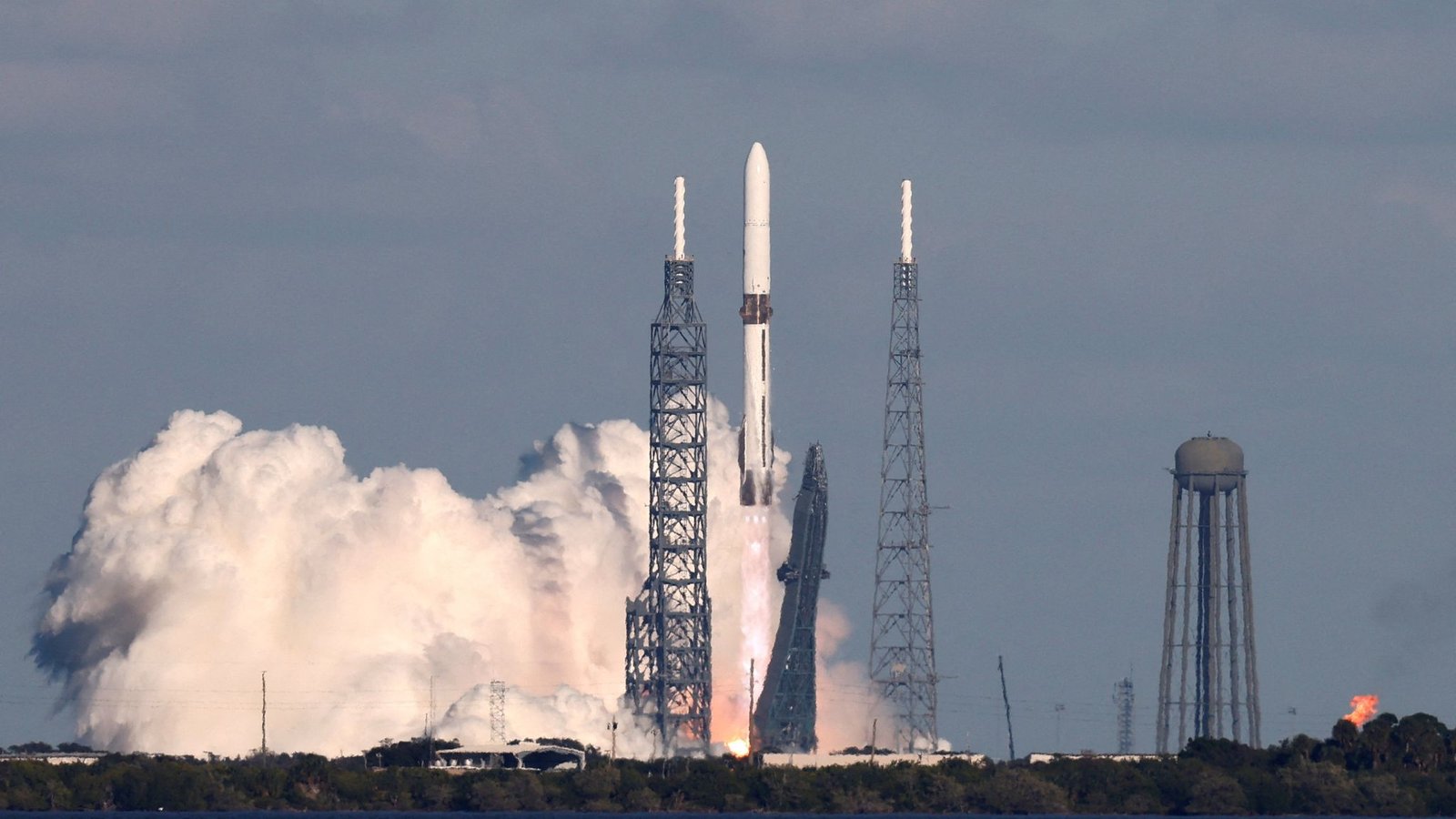
Cheers erupted across Cape Canaveral Space Force Station in Florida as Blue Origin successfully launched its New Glenn rocket after days of turbulence caused by weather and last-minute delays. The long-anticipated mission marked a defining moment for the company, not only for sending NASA spacecraft toward Mars but also for achieving a breakthrough landing of its reusable first-stage booster—an accomplishment that intensifies the competitive space race with SpaceX.
A Launch After Days of Setbacks
The liftoff had initially been postponed four consecutive days because of unfavorable weather conditions. The mission faced two more delays on Thursday before the final countdown cleared. When the rocket ultimately soared into the sky, crowds gathered along Florida’s coast watched a moment years in the making.
Onboard were two identical Mars orbiters known as EscaPADE (Escape and Plasma Acceleration and Dynamics Explorers). These twin spacecraft are designed to study the magnetic and atmospheric environment of Mars and are expected to reach the Red Planet in 2027.
A Critical Milestone: Booster Recovery at Sea
While the scientific mission holds major significance, the day’s biggest triumph came moments after the booster separated from the rocket. Blue Origin successfully landed the reusable first-stage booster upright on a recovery platform 375 miles (600 kilometers) offshore in the Atlantic Ocean—a feat the company had never achieved with a rocket of this size.
Inside Blue Origin’s mission control, team members erupted with celebration as the booster touched down. For Blue Origin, the accomplishment represents a major leap forward. Reusable booster technology drastically reduces launch costs and is essential for high-frequency, large-scale missions. SpaceX has long mastered this capability, and Blue Origin’s success signals that competition in commercial spaceflight is narrowing.
Elon Musk acknowledged the achievement, posting his congratulations on X shortly after the landing.
New Glenn: A Massive Rocket Built for Ambitious Missions
The New Glenn rocket, named in honor of astronaut John Glenn, is one of the largest operational rockets in the world.
Key specifications include:
- Height: 98 meters
- Diameter: 7 meters
- Payload capacity: 45 metric tonnes
- Total mass: Comparable to roughly 20 fully loaded trucks
Although smaller than SpaceX’s Starship and NASA’s historic Saturn V, New Glenn is designed for deep-space missions, heavy payloads, and long-term reusability—making it a central pillar of Blue Origin’s future plans.
This launch marked only the second flight of New Glenn. The first test flight earlier in the year successfully placed a prototype satellite in orbit but failed to recover the booster. This successful landing signals that Blue Origin has crossed a crucial engineering threshold.
Separation and Deployment: Mission Success in Orbit
After leaving the Earth’s atmosphere, the rocket’s upper stage continued its journey into orbit. It successfully deployed the pair of Mars orbiters, which will now begin their years-long cruise toward Mars. Once they arrive, they will help scientists unravel how solar wind interacts with Martian plasma and atmosphere—information essential to understanding the planet’s evolution and its potential habitability.
A Turning Point in the Commercial Space Race
Blue Origin has previously demonstrated booster recoveries with smaller rockets, but performing this maneuver with a large, heavy-lift launcher places the company in a new competitive tier. If Blue Origin intends to become a primary launch provider for long-term NASA science missions and future deep-space transportation, consistent booster recovery will be critical.
SpaceX has set the global standard for reusable launch systems, performing dozens of successful landings and revolutionizing rocket economics. Blue Origin’s success brings genuine competition to that landscape and signals that the commercial space sector is becoming more technologically diverse and increasingly ambitious.
A New Era Begins for Blue Origin
The company’s latest achievement not only strengthens its partnership with NASA but also underscores the growing capabilities of private firms in deep-space exploration. As the EscaPADE orbiters begin their journey to Mars and engineers analyze data from New Glenn’s first booster landing, Blue Origin enters a pivotal new era—one defined by reusability, scientific advancement, and intensified rivalry within the global space industry.