













The realm of space exploration has witnessed the retirement of a true legend. Europe’s renowned Ariane 5 rocket, a stalwart in space launchers, has completed its final mission, marking the end of an era that has left an indelible mark on the history of space exploration.
A Legacy of Reliability and Success
With its inaugural launch in 1996, the Ariane 5 rocket quickly established itself as Europe’s most reliable and formidable launcher. Throughout its operational career, it surpassed the achievements of its predecessors, solidifying its position as the European Space Agency’s (ESA) primary launch vehicle.
Delivering Satellites to New Heights
The Ariane 5 rocket has been pivotal in delivering many satellites into orbit, contributing to vital scientific research, communication networks, and Earth observation capabilities. Notably, it has facilitated the deployment of NASA’s iconic James Webb Space Telescope, which promises to revolutionize our understanding of the cosmos. With an impressive success rate of 112 out of 117 missions, the Ariane 5 has consistently demonstrated its reliability and precision.
Final Mission: A Fitting Finale
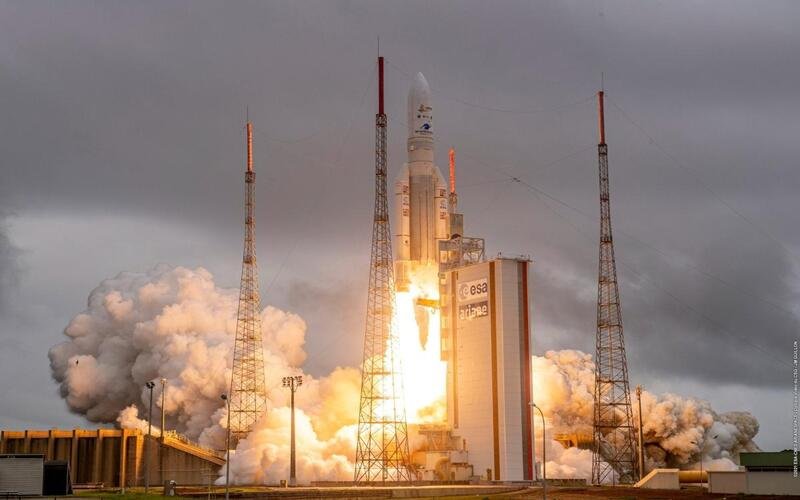
The final launch of the Ariane 5 rocket was poignant and awe-inspiring. Embarking on its ultimate journey, the rocket flawlessly carried two significant payloads. The Heinrich-Hertz-Satellit, designed to test advanced communication technologies, and the Syracuse 4B satellite, serving the French military, were successfully deployed into their intended orbits. The images capturing the final launch depict the extraordinary sight of the rocket piercing the sky, with its solid rocket boosters illuminating the surroundings.
A Gap in the Launch Horizon
The retirement of the Ariane 5 leaves Europe facing a temporary gap in its launch capabilities. Until the highly anticipated Ariane 6 rocket arrives, Europe will rely on alternative launch options, including collaborations with other nations and commercial providers. The Ariane 6, designed to compete with SpaceX’s Falcon 9, promises enhanced performance and cost efficiency. Scheduled for its inaugural test launch in late 2023 or possibly 2024, the Ariane 6 aims to again position Europe at the forefront of the space launch industry.
Looking to the Future: Ariane 6 and Beyond
As Europe transitions to the Ariane 6, it focuses on successfully launching this state-of-the-art rocket and ensuring its seamless integration into the European space launch ecosystem. The Ariane 6 will not only serve as a successor to the Ariane 5 but also position Europe to tackle emerging challenges in space exploration. With anticipated commercial operations commencing in 2024, the Ariane 6 will support a wide range of missions, including the deployment of Amazon’s Kuiper satellite constellation and Europe’s Galileo navigation system. While it may not incorporate reusability like its Falcon 9 counterpart, the Ariane 6’s cost projections indicate that reusability would not be cost-effective given the expected launch frequency.
The Challenges Ahead
While the retirement of the Ariane 5 marks the end of an illustrious chapter in Europe’s space launch history, it also underscores the challenges ahead. Technical issues affecting Italy’s Vega rocket, geopolitical tensions impacting access to the Russian Soyuz, and delays in the Ariane 6 program all contribute to a critical period for Europe’s space industry. However, these obstacles only amplify the importance of successfully launching the Ariane 6 and establishing a robust and competitive European launch ecosystem.
A Fond Farewell
As we bid farewell to the Ariane 5 rocket, we reflect on its extraordinary contributions to space exploration and scientific advancement. Its legacy of reliability, precision, and successful missions has left an indelible mark on the European space industry. With the arrival of the Ariane 6 on the horizon, Europe stands poised to embrace a new era of space launch capabilities, pushing the boundaries of human knowledge and unlocking the mysteries of the cosmos.