














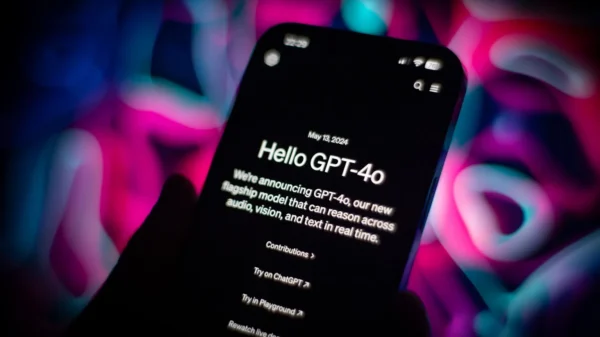





















OpenAI has introduced GPT-5.2, its newest frontier model, marking a significant escalation in the escalating rivalry with Google’s rapidly advancing Gemini ecosystem. Released to developers and paid ChatGPT users, GPT-5.2 arrives at a pivotal moment for the company as it works to regain momentum amid concerns about user growth and market share.
The model launches in three specialized versions aimed at different workloads. GPT-5.2 Instant is built for speed, powering everyday tasks such as writing, translation, and general information queries. GPT-5.2 Thinking targets more demanding cognitive workloads, excelling in long-context analysis, coding, mathematics, and multi-step planning. GPT-5.2 Pro, the top-tier variant, is designed for maximum reliability in complex professional environments.
According to OpenAI’s leadership, the new system is engineered to boost productivity across sectors. The model reportedly delivers major improvements in tasks such as spreadsheet creation, presentation building, code generation, and image interpretation. These advancements arrive as Google integrates Gemini 3 more deeply across its cloud services, fueling a competitive environment that has prompted internal urgency at OpenAI.
Earlier reports revealed a “code red” directive within the company, urging teams to refocus on enhancing ChatGPT’s core experience rather than diversifying into advertising and other initiatives. GPT-5.2 is positioned as part of this renewed push, strengthening OpenAI’s enterprise strategy and cementing its tools as foundational infrastructure for AI-driven applications.
Benchmarks released by OpenAI show GPT-5.2 outperforming rivals like Gemini 3 and Claude Opus 4.5 in areas including software engineering, advanced scientific reasoning, long-context comprehension, and logical pattern recognition. Researchers emphasized that strong math and logic performance is increasingly crucial, as these skills underpin essential tasks such as forecasting, data modeling, debugging, and financial analysis.
GPT-5.2 also refines OpenAI’s previous upgrades, building on the unified architecture introduced in GPT-5 and the improved conversational and reasoning features from GPT-5.1. With 38% fewer errors in complex reasoning tasks, the new model aims to deliver more stable, production-grade performance for professionals.
Despite these advancements, the launch notably lacked a new flagship image generator a feature highlighted as a priority in internal communications. Google’s recent viral success with its “Nano Banana” image models has heightened expectations for OpenAI’s next move, with rumors pointing to an updated image system expected early next year.
As OpenAI invests heavily reportedly into the trillions in future infrastructure, GPT-5.2 signals a strategic move to reclaim leadership in the AI race while preparing for increasingly sophisticated, compute-intensive demands.