



































Reeking coagulations of grease and debris are clotting sewers around the world on a colossal scale. Cities are deploying new technologies to control this modern menace.
Beneath the bustle of pedestrians and traffic on London’s Whitechapel Road, something truly horrific was taking shape. It weighed more than 130 tonnes – the same as 11 of the city’s famous red double decker buses – and breathed toxic fumes.
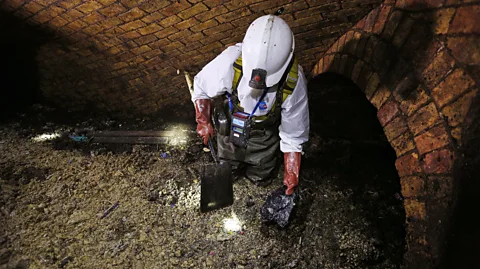
This subterranean monster had been growing unnoticed in the Victorian-era sewer running underneath the busy street, until workers carrying out a routine inspection bumped into its rock-hard flank. Now, a team wielding pickaxes, high-pressure water jets and clad head-to-toe in protective clothing, were preparing to tackle the putrid beast.
Their foe? A stomach-churning agglomeration of fat, oil, grease, wet wipes, sanitary products and condoms, known as a “fatberg”.
This unholy concoction turns out to be “a magical mixture” that hardens like concrete, says Richard Martin, head of treatment improvement at Southern Water, a water company responsible for sewers in the southeast of England.
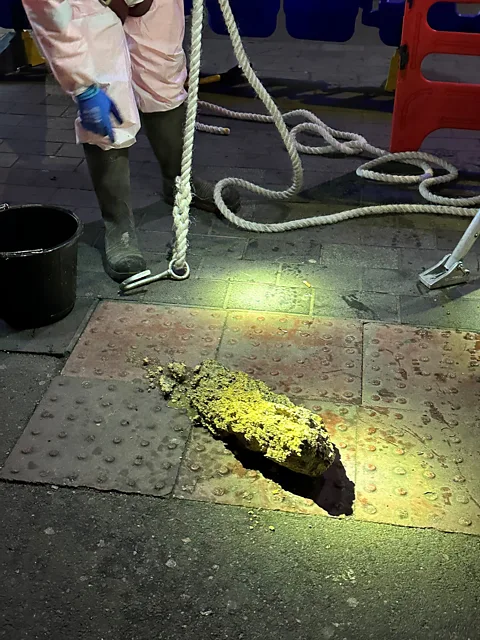
These hideous clogs menace cities around the world. Formed from material that householders and businesses flush down the drains, they block sewer systems, causing flooding and sewage pollution to spill out into nearby rivers. Homeowners and businesses can find sewage backing up into their property or the streets outside if the worst fatbergs are not tackled. They can form quickly and unpredictably.
It would take workers from Thames Water – the company responsible for London’s sewer system – nine weeks to dig out the coagulated mass beneath Whitechapel in 2017. But at the end of 2025, sewage workers discovered it had returned, regrowing to more than 100 tonnes.
Hidden in the dank netherworld of the sewer network, they form far out of sight
Water companies in the UK tackle an estimated 300,000 of these accumulations of coagulated fat, oil and grease every year. New York City – where 40% of sewer backups are due to grease – spends around $18.8m (£13.8m) annually degreasing and removing blockages from the sewers beneath its streets.
And behemoths rivalling the Whitechapel specimen raise their ugly heads with alarming frequency. Giant fatbergs have been discovered lurking beneath the suburbs of Detroit and Baltimore in the US, Liverpool and Oxford in the UK, and Melbourne and Sydney in Australia.
The challenge is detecting these fatty blockages before they reach such gargantuan proportions. Hidden in the dank netherworld of the sewer network, they form far out of sight – from materials we’d rather forget as soon as we flush them.
Now, water utilities are turning to new technology to help them in their subterranean battles with fatbergs, using artificial intelligence to help them spot the signs of a fatty build-up so they can act early.
Early warnings
In the UK, Southern Water has deployed around 34,000 sensors in its sewers. The sensors are attached to manhole covers and use radar, pinging out a signal that bounces off the water in the sewer below, to check the level.
These measurements are fed into a machine learning algorithm – a form of AI – which combines them with information on rainfall and weather data to produce estimates for what should be a normal water level on any given day. “If it pops outside of that band, that’s when we react,” says Martin.
 Getty Images
Historically, water companies have relied on customer tip-offs or routine inspections to learn of the presence of fatbergs. With AI-powered tip-offs, it’s much easier to clear blockages before they grow and ossify, giving companies more time to respond and meaning less sewage seeping out into the environment.
Another upside is keeping workers out of the foul subterranean network as much as possible. “It’s not a very pleasant environment,” says Martin. Workers need to wear breathing apparatus due to high levels of hydrogen sulphide (a toxic gas which produces a rotten egg smell), methane and carbon dioxide. They also risk exposure to viruses, bacteria, and parasites.
Southern Water has cleared 700 blockages using AI so far this year. Last year, it was between 3,500-4,000 blockages in total. “A lot of these might have resulted in internal flooding, external flooding, pollution,” says Martin. Even so, the water company still saw more than 15,500 sewage spills in 2025 due to sewers being blocked or overwhelmed, but it marked a 47% drop compared to 2024
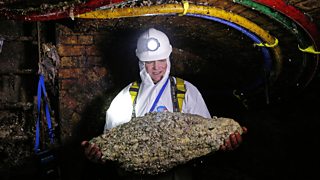
Fatbergs come in many shapes and sizes. A 300-tonne monster in Birmingham – excavated in 2021 – barely cleared 3ft (0.9m) in height but snaked for a queasy 1km (0.6 miles).
The one found under Whitechapel in 2017 towered more than 6ft (1.8m) tall and stretched for 250m (820ft). And the smell? Like rotting meat mixed with the odour of a smelly toilet.
Recently, an enormous fatberg in Sydney was found to be ejecting foul-smelling “poo balls” that washed up on beaches around New South Wales in Australia.
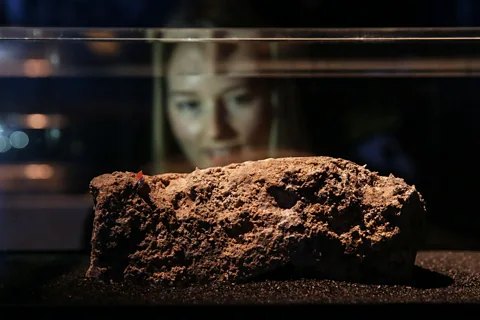
Surprisingly, some of these fatbergs have become attractions in their own right. Chunks of the Whitechapel fatberg have gone on display in a museum in London, while scientists were also eager to get hold of it.
Cafe cheese
From a large test tube on a shelf behind her desk, Raffaella Villa removes a lump of the Whitechapel fatberg that she claimed as a memento. Head of the school of engineering at Lancaster University, UK, Villa was involved in analysing the fatberg for the Museum of London.
She crumbles the white substance – which has been dried – between her fingers. “It’s quite hard. The texture is a bit like soap; it’s quite waxy.” She puts it down and reaches for sanitiser. “Let me clean my hands.”
 Getty Images
Villa says the precise chemical processes underlying fatberg formation needs to be studied more closely. In addition to fat, grease and oil, she suspects that milk could play a role in helping the unappetising mixture coagulate. “In a coffee shop waiting for my cappuccino, I saw baristas pouring lots of milk down the drain,” she says. “Next to it, there’s a dishwasher that discharges hot water with a very high pH – which are the conditions for cheese-making. If this is happening in the sewer, that could be triggering the fatberg.” She points out that cheese starts out soft and becomes harder as it matures. “Fatbergs are very similar.”
It’s already known that kebab alleys, home to takeaway food joints where simmering vats of oil can often be improperly poured down drains, are fatberg hotspots. Villa wonders if coffee shops might add their own ingredients to the noxious brew sluicing beneath our feet.
The mysteries of fatbergs might be better understood by pointing AI at them. Villa has applied for funding to sample sewers and use machine learning to direct water companies to the most “mature”, hardest and immovable fatbergs first.
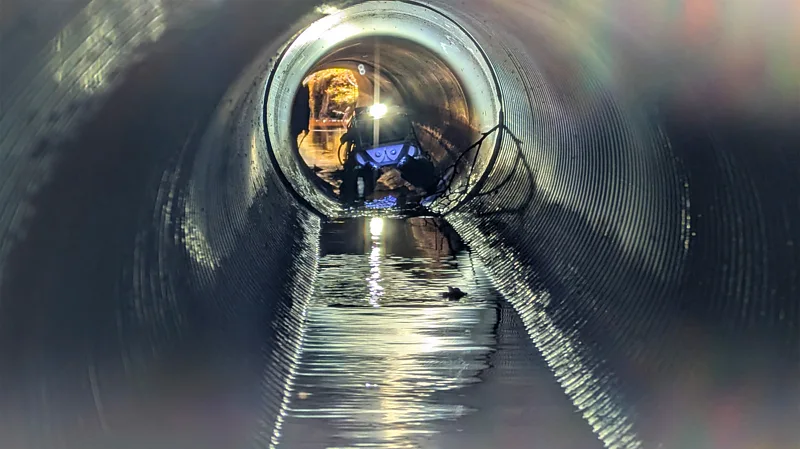
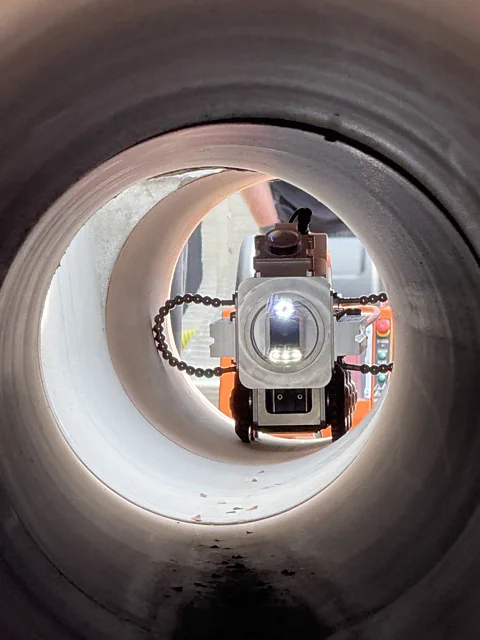
Fleets of autonomous robots could also help to keep the fatberg problem in check. Cities in the UK and US have long sent simple camera-equipped robots into sewers to capture footage that can be used to identify troubling signs like incipient fatberg buildups. These are often manually controlled by a remote operator.
 Thames Water
Lately, there has been a push to kit these bots out with more sensors and the means to deal with blockages – reducing the need for a PPE-clad human to descend into manholes. One day these could function completely autonomously, comprising a self-sustaining clean-up system operating out of sight.
Sewer bots
An €8m (£7m/$9m) EU-funded project has brought together a consortium of universities and companies to develop exactly this technology. Tallinn University’s robot prototype – currently still under development – has been dubbed a tardigrade, in a nod to the microscopic, eight-legged aquatic invertebrates known for being the hardiest creatures on Earth
“The robot, with its sensing capabilities, can self-localise inside the sewer network,” says Lyudmila Mihaylova, professor of signal processing and control at the University of Sheffield in the UK, who is working on the EU project. “It can inspect and detect blockages. The plan is that there will even be an arm that can grasp and remove them.”
The robot is fitted with optical cameras, acoustic sensors, LiDAR, and inertial measurement units to track the dynamic world of the sewer. “We are developing machine learning algorithms that equip the robots with the tools to work in these complex environments,” says Mihaylova.
 Pipeon project
Growing amounts of data yielded by sensor and camera-laden bots means AI is increasingly needed to decipher it. “I’ve spent probably a lot of my career watching footage from inside sewers,” says Eric Sullivan, director of strategic development at SewerAI, a company based in the US. “Most of that footage is quite uneventful. That’s precisely the problem that we’re tackling.”
Traditionally, humans have reviewed this footage – a boring and arduous task – but SewerAI has automated the process, making it faster and more efficient. “What we do is probably closer to radiology than plumbing… interpreting these images for signs of trouble, for defects,” says Sullivan.
Sewer bots need to be resilient, says Mihaylova. They must be waterproof, able to withstand the pressure from wastewater, and be resistant to the corrosive waste products swirling in their environment. There are also communication challenges: Wi-Fi and Bluetooth networks don’t work easily underground. But Mihaylova says that working through these issues will be worth it, predicting that sewer bots will eventually “lead to significant savings”.
Another boon will be “protecting workers from being exposed to the harmful environment of the sewers”, says Mihaylova. The days humans must spend in a filth-coated tunnel, hacking and blasting their way through a wall of coagulated fat, might, mercifully, be numbered.