
































COPENHAGEN, Denmark — When Mary had her first child, she began noticing a dramatic change in her husband’s behavior around money.
The couple had agreed in their 2011 Danish prenuptial agreement to combine their finances. But that arrangement never happened. Instead, Mary depended on regular transfers from her husband, who was the family’s sole earner, while she worked toward a master’s degree.
Whenever she raised the idea of opening the joint account they had discussed, the conversation would turn into an argument. Her husband also began questioning her about her spending.
“I felt a bit like he was an investigator,” Mary said.
She asked that her real name not be used because of an ongoing legal case involving her former husband.
At the time, her ex-husband earned as much as 4 million kroner a year, roughly $610,000 in 2015. Mary said he typically gave her about 6,000 kroner, or $915, a month to cover expenses for herself and their two children.
She said he discouraged her from finding work and would not assist with childcare, leaving her financially dependent on him. Even the amount she received could change without warning.
“If he thought he’d already paid for petrol, for example, or if I didn’t deserve the money, he could deduct it,” she said. “So I could never quite count on what I’d get.”
The situation became even more disturbing in early 2015, when Mary’s bank adviser contacted her after noticing repeated logins to her online banking account. She initially insisted the adviser was mistaken.
Then she realized who had been accessing the account.
“It wasn’t me. It’s my husband who has logged in,” she recalled telling him.
Her husband had used her NemID credentials, Denmark’s former digital identification system, to access the account approximately 21 times. The bank adviser offered to report the activity, but Mary declined.
“Looking back, I think I should have just had it reported,” she said, noting that the records could have provided evidence of a broader pattern.
Mary does not know how many other times her digital identity was used during their 11-year relationship. But the experience illustrates what researchers describe as economic violence — a form of domestic abuse involving financial control, coercion or exploitation.
What can initially appear to be separate incidents — controlling spending, restricting access to money, monitoring bank accounts or taking control of financial assets — can form a larger pattern of abuse.
“I often had this image in my head – that he was a cat, and I was a mouse,” Mary said.
Denmark’s digital dependence
Economic violence has historically received less attention than other forms of domestic abuse. Researchers are now examining how increasingly digital financial systems and national identification platforms can give abusive partners additional tools for control.
Denmark is among Europe’s most digitally advanced countries. Its first national digital identification system, NemID, launched in 2010. In 2021, it was replaced by MitID, a smartphone-based digital identity system used to access services ranging from banking to tax and health information.
Although MitID is not legally mandatory, avoiding it can make everyday life extremely difficult. Danish residents commonly use it to open bank accounts, pay taxes and access essential public services.
MitID introduced stronger authentication, including biometric verification. Users can generally confirm their identity by scanning their face through the MitID application.
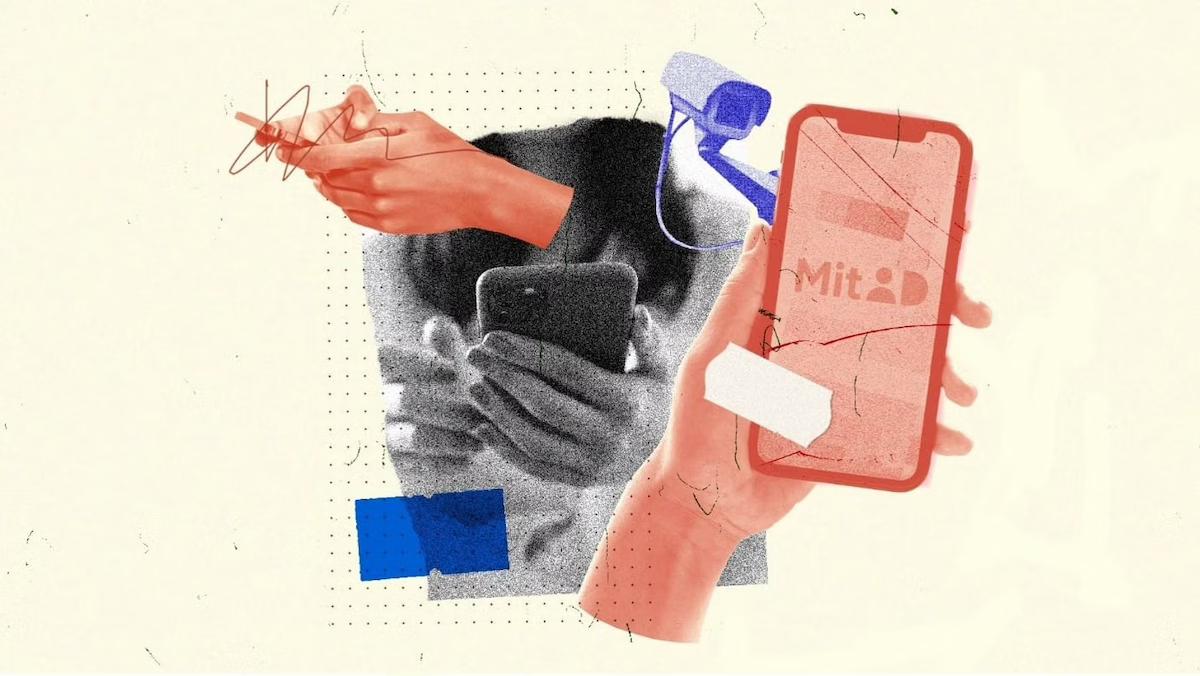
Image by Gabrielle Smith for Fuller
Malte Bundgaard Kolze, a criminologist and researcher at Copenhagen-based legal think tank Justitia, said the system offers strong protection against strangers attempting to gain unauthorized access.
But intimate partners present a different risk.
An abusive partner may be physically close to the victim and able to pressure, manipulate or coerce them into completing biometric authentication themselves.
“Against strangers, it’s very effective. But against intimate partners, it’s not because they’re close to you,” Kolze said.
When digital security becomes difficult evidence
That creates another problem when victims attempt to prove that financial abuse occurred.
Maja Wallmeier Wolfgang, a criminologist who consults for the Nordjylland regional police department, said economic-violence cases can be difficult to investigate because of questions surrounding consent.
If a transaction or login was completed using a victim’s MitID credentials, investigators may struggle to determine whether the person acted voluntarily, whether someone else gained unauthorized access, or whether the victim was manipulated into authorizing the transaction.
Finance Denmark, the country’s banking industry association, said it sympathizes with women subjected to economic violence and works with organizations including Danner and LOKK, the national association of women’s shelters.
However, Kjeld Gosvig-Jensen, Finance Denmark’s deputy director of law, said the organization has no independent ability to intervene in how MitID itself is used.
Denmark’s government agency responsible for digital services did not respond to Fuller’s request for comment.
A debt that can follow victims for years
Across the European Union, approximately one in five women experiences some form of economic violence, according to the European Union Agency for Fundamental Rights. Only nine European countries specifically criminalize economic violence, and Denmark is not among them.
Denmark did criminalize psychological violence in 2019, including behavior involving control over another person’s finances. But advocates say the definition does not fully capture the range of economic abuse.
Digital identity systems can potentially be used to take out loans, redirect welfare payments, move money or create financial obligations in another person’s name.
In Denmark, so-called quick loans can be approved within minutes, with funds sent to a bank account chosen by the borrower.
Justitia has highlighted cases in which perpetrators used digital identities to obtain such loans without their partners’ knowledge.
A compensation scheme exists for victims of certain forms of digital-signature fraud, but researchers say it does not necessarily cover economic abuse. For example, victims may not qualify when an abusive partner uses their digital identity to obtain a loan and directs the money into the perpetrator’s own account.
Danish broadcaster DR reported one case involving a woman whose boyfriend used her NemID in 2017 to take out a 40,000-kroner loan, worth about $6,200. Although he was later convicted of fraud, the woman was still pursued by a bank for repayment of the loan and interest.
Kolze described the resulting financial consequences as a potential “chain around the ankle” that can continue long after a relationship ends.
In another case documented by Danner, a woman named Tahmina discovered years after leaving her former partner that Denmark’s tax authority said she owed nearly 500,000 kroner, or about $78,120. Her former partner had allegedly used her digital identity to establish a company and accumulate debt in her name.
Economic abuse often goes unnoticed
Experts say economic violence is also poorly recognized by institutions that victims turn to for help.
Denmark allocated 25 million kroner, nearly $4 million, this year toward police efforts addressing intimate-partner violence. But advocates say economic abuse is not always identified as part of those cases.
Danish economist and author Anne-Mette Barfod said several women had told her they reported financial abuse to police but felt officers failed to recognize it as a broader pattern.
A 2022 study published in the Nordic Journal of Criminal Science found that economic violence appeared in only 35 of 357 Danish police reports containing case summaries involving psychological violence.
Wolfgang said clearer legal definitions could help police identify and investigate economic abuse.
“The police don’t have a fully concrete definition of economic violence,” she said.
A wider European concern
Denmark is not alone in facing problems involving digital identity and financial abuse.
Swedish police have identified economic abuse involving digital IDs as an issue, while similar cases have been reported in Norway.
In the United Kingdom, economic abuse is recognized in law. Surviving Economic Abuse estimates that one in six women in the country has experienced economic abuse by a current or former partner within a 12-month period.
The charity Refuge has also reported a 78% increase in referrals involving technology-facilitated and economic abuse over the past year. One survivor described how her partner accumulated debts in her name, including financing for a luxury vehicle worth more than £100,000.
The issue could become even more significant as the European Union prepares to roll out European Digital Identity Wallets across the bloc. Researchers examining cases from Scandinavia have warned that the misuse of digital identities by intimate partners should be considered as policymakers develop the new system.
The consequences can last beyond the relationship.
Mary now lives with her children in an apartment. Since filing for divorce in 2022, she has gained a clearer understanding of how financial control operated throughout her marriage.
For her, economic violence was not defined by one dramatic event. Instead, it emerged through a series of seemingly separate behaviors — restrictions on money, financial monitoring and control over access to resources.
She believes the problem is still frequently misunderstood because people associate economic violence simply with money.
“But it’s psychological. It completely undermines your foundation,” she said.