

































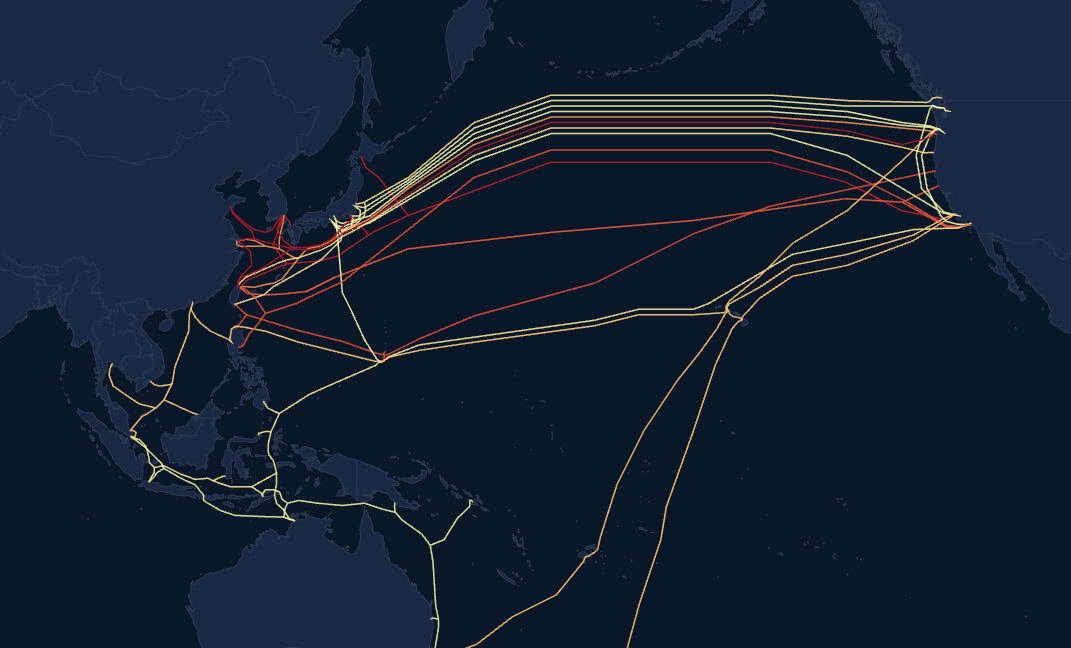
Undersea internet cables connecting the United States with Asia are facing increasing security risks as Chinese research vessels conduct extensive surveys near critical infrastructure and ships linked to China come under scrutiny over cable damage. A new report warns that potential sabotage could disrupt global internet traffic, cloud computing and financial services.
The findings highlight growing concern over the vulnerability of the underwater cables that carry much of the world’s international data. Although most cable damage results from accidents, rising geopolitical tensions have prompted analysts to investigate whether some incidents could be deliberate attempts to disrupt communications.
US-owned cable projects are among the highest-risk targets
A September 2026 report commissioned by the US-China Economic and Security Review Commission identifies several trans-Pacific cable projects involving major American technology companies as particularly vulnerable to potential interference.
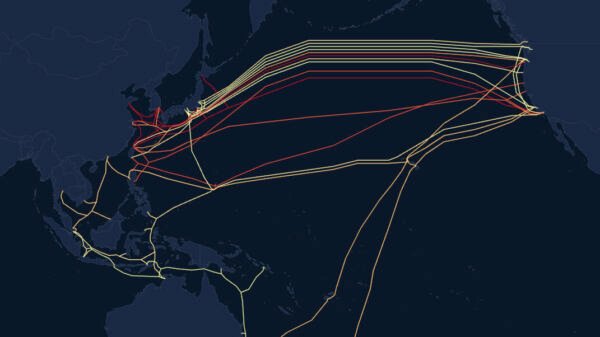
The report, prepared by the London-based China Strategic Risks Institute, introduces an interactive Trans-Pacific Cable Gray Zone Vulnerability Index. The tool ranks cable routes according to their exposure to possible sabotage and other hostile activities designed to remain below the threshold of open military conflict.
Researchers assessed several factors, including underwater depth, nearby shipping traffic, cable ownership, China’s maritime claims and whether a cable connects to Taiwan.
The findings point to waters around Taiwan, Japan and the Philippines as especially vulnerable. Many international cable routes in these areas pass through relatively shallow waters and busy shipping lanes, increasing their exposure to accidental damage and potential interference.
Three projects featuring significant American corporate investment ranked among the five highest-risk cables: Google’s TPU project, Meta’s ORCA cable and the E2A cable, co-owned by Verizon and companies in Japan, South Korea and Taiwan.
The researchers say identifying vulnerable routes could help governments and operators determine where underwater sensors, monitoring systems and maritime patrols would be most effective.
A major cable disruption could affect global internet services
The report warns that damage to a single major trans-Pacific cable could overwhelm the available capacity on direct connections between the United States and Taiwan, Japan and the Philippines.
Internet traffic would have to be redirected through alternative routes, potentially resulting in slower connections and reduced network capacity.
A more extensive disruption involving several cables could have far greater consequences, particularly during a geopolitical crisis involving Taiwan. The researchers warn that multiple failures could overwhelm trans-Pacific capacity and force communications between the United States and the Indo-Pacific region onto longer routes through other parts of the world.
Such an event could affect cloud services, international communications, financial trading and businesses that depend on reliable cross-border data transfers.
Chinese research ships raise new questions
Concerns about potential sabotage have intensified alongside the development of military submarines, underwater drones and specialised equipment capable of cutting or repairing subsea cables.
An October 2026 report from the Washington-based Center for Strategic and International Studies (CSIS) examined the movements of more than 200 research vessels from multiple countries between 2020 and 2025.
The researchers found that Chinese-flagged research ships spent unusually long periods near undersea infrastructure. Some displayed movement patterns consistent with seabed surveying close to cable routes, rather than focusing primarily on areas known for undersea mineral deposits.
The report said this activity stood out even against the generally substantial operations of American and Russian research vessels.
Seabed-mapping technology has legitimate scientific and commercial applications, but it can also reveal information about the location and characteristics of underwater infrastructure. This dual-use capability has raised questions about whether some surveys could potentially support future interference with critical cables.
The findings do not, by themselves, establish that the vessels were preparing to sabotage cables. However, they add to concerns about the strategic value of detailed knowledge of the seabed.
Previous cable damage near Taiwan adds to tensions
Several cable-cutting incidents involving Chinese-owned fishing boats and cargo vessels have drawn attention in recent years, particularly around Taiwan.
In one incident in 2025, a Chinese ship damaged the Tai-Peng 3 cable, which connects Taiwan to the Penghu islands. The vessel reportedly dropped anchor and followed a zigzag pattern before the damage occurred.
Taiwan subsequently convicted the ship’s Chinese captain and sentenced him to three years in prison. According to the report, this was the first case in which Taiwan’s government secured a conviction and prison sentence against a Chinese captain over such an incident.
The episode added to concerns about the security of Taiwan’s communications infrastructure amid growing military and political tensions with Beijing.
Undersea cables are difficult to monitor continuously across vast stretches of ocean, making it challenging to distinguish deliberate interference from ordinary maritime accidents.
Russia and China face scrutiny over incidents in European waters
The growing threat extends beyond the Pacific. Ships linked to Russia and China have also been investigated over damage to communications cables, power lines and pipelines in the Baltic Sea. Some incidents involved vessels dragging their anchors for unusually long periods.
An analysis published by The Telegraph on October 21 identified more than 500 incidents involving Russian fishing vessels operating near critical undersea cables connecting the United Kingdom to the rest of the world. Some vessels reportedly travelled along cable routes.
Reuters has also reported that NATO countries confronted Russian submarines earlier in 2026 after they practised disabling undersea cables using new technology in Arctic waters near Norway.
These developments have increased concerns that undersea infrastructure could become a target in geopolitical confrontations, allowing countries to disrupt essential services without engaging in direct military conflict.
Iran’s threats add another potential flashpoint
The Strait of Hormuz has emerged as another area of concern. Iran has repeatedly threatened to charge US technology companies fees for internet cables passing beneath the contested waterway and has reportedly prepared plans to attack them.
The issue adds to the risks surrounding global communications infrastructure amid the wider war that began when the United States and Israel attacked Iran in February 2026.
Because international data networks depend on cables crossing strategically important waterways, a disruption in one region can have consequences far beyond the immediate area.
Protecting the internet’s underwater backbone
Undersea cables are essential to the modern digital economy, supporting international phone calls, online transactions, cloud computing, streaming and data transfers between continents.
Although alternative routes can keep traffic moving when an individual cable fails, simultaneous disruptions could strain the remaining network and cause significant service degradation.
The latest reports underscore the need for stronger monitoring, better protection of vulnerable cable routes and improved coordination between governments and private operators.
However, distinguishing hostile activity from legitimate research, fishing and commercial shipping remains difficult. The same equipment used to inspect and repair cables can also be adapted for sabotage, complicating efforts to assess potential threats before damage occurs.
As competition between major powers intensifies, protecting the internet’s underwater infrastructure is becoming an increasingly important part of national security and global economic resilience.