







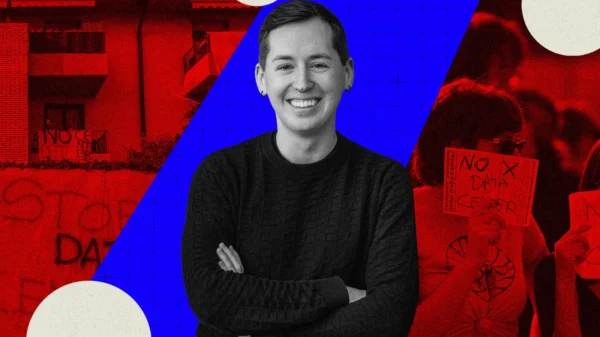




























Opposition to large-scale data center projects is creating an unusual divide among Florida Republicans. With the 2026 governor’s race tightening, the issue is giving Democratic candidate David Jolly an opening to court voters who have traditionally supported the GOP.
Florida’s growing resistance to data center development is emerging as an unexpected issue in the state’s 2026 gubernatorial election. Opposition has spread across party lines, putting Republican nominee Byron Donalds under pressure and creating an opportunity for his Democratic challenger, former congressman David Jolly, to attract voters concerned about the influence of major technology companies.
For Patti Zirhut, a lifelong Republican who supported Donald Trump in the 2016, 2020 and 2024 elections, this year’s ballot looks very different. She has spent weeks weighing her choices and plans to split her vote among Republicans, independents and Democrats. One decision, however, is settled: she will not vote for Donalds.
Zirhut, an organizer with No Data Center Hernando County, objects to Donalds’ support for the controversial developments and the technology industry backing his campaign. She is now considering voting for Jolly, a former Republican who left the party in 2018.
Data centers become a campaign issue
Donalds enters the race with Trump’s endorsement, strong Republican Party support and approximately $148 million in campaign funds, much of it linked to the technology sector. His support for data center development has become a point of contention among residents who fear the projects will affect their communities.
Jolly, meanwhile, has made opposition to the developments a central part of his campaign. He has visited Virginia’s Loudoun County, widely known as Data Center Alley, to examine the effects of large hyperscale facilities on local communities. He has also promised a one-year moratorium on new data center projects in Florida.
Donalds has taken a different position, emphasizing his ambition to make Florida a major financial center and welcoming technology companies to the state. In August, he dismissed the idea of banning data centers, saying there would be no bans despite the political appeal of such proposals.
His position has since become more measured as opposition has grown. A reported 68 percent of Floridians say they oppose data center developments in their communities.
Jolly argues that resistance is particularly strong among Republicans because the issue reflects broader concerns about the power of large technology and data companies. He says residents are worried about surveillance, artificial intelligence and development encroaching on their property and personal freedom.
Environmental and community concerns
Jolly has outlined several reasons for slowing data center construction, including air and noise pollution, public health concerns associated with on-site power plants and the environmental demands of operating the facilities.
Water consumption is another major concern, although Jolly acknowledges that the industry’s move toward closed-loop air-cooling systems may reduce some of the pressure on local water resources.
He has also questioned whether facilities being constructed today will remain useful as artificial intelligence technology continues to evolve. Given the speed of change, he argues, some of these developments could become functionally obsolete within a decade.
Donalds has pointed to legislation sponsored by his running mate, state Senator Bryan Ávila, which would require new data center projects to pay their fair share of water and electricity costs.
He has also argued that local governments, rather than the governor, have the final say over development approvals. According to Donalds, governors do not issue building permits, and communities that oppose a project can rely on their local authorities to prevent it.
Jolly, however, has given his opponent the nickname “Data Center Donalds,” making the contrast between their positions a recurring feature of the campaign.

Local opposition reaches deep-red communities
The debate is particularly visible in Polk County, where the Watchdogs of Fort Meade community group is fighting a proposed $2.6 billion hyperscale data center.
The group’s chair, Raul Alfonso, says it has contacted political candidates to discuss residents’ concerns. Earlier in the year, both Donalds and Florida Governor Ron DeSantis sent responses that Alfonso characterized as form letters, directing residents to trust their local elected officials to make the appropriate decisions.
The group has not received a response from Jolly, although Alfonso says that is less concerning given the candidate’s pledge to pause development.
Other candidates have been more directly engaged. Republican contender James Fishback, who received 10 percent of the primary vote, was the first to respond to the group. Bobby Williams, another Republican candidate who received 4.1 percent, attended several community events. Angie Nixon, the Democrat challenging Senator Ashley Moody, also held a town hall in Fort Meade to discuss opposition to the proposed developments.
For Alfonso, engagement matters as much as party affiliation. He says residents have seen candidates with very different political positions take their concerns seriously, while Donalds has not demonstrated the same level of direct involvement.
Alfonso has traditionally voted conservatively, supporting Trump in all three of his presidential campaigns. He was registered as an independent until this year, when he changed his affiliation to Republican so he could vote for Williams in the primary.
Williams, a pastor with no previous political campaign experience, has since endorsed Jolly. He argues that major corporations are exerting too much influence over political campaigns and decision-making, describing data center developers as the latest outside interests seeking to shape Florida’s future.
A close race with significant financial differences
If elected, Jolly would become Florida’s first Democratic governor in 28 years. Recent polling has shown a competitive contest. A University of North Florida survey placed Jolly two percentage points behind Donalds, within the poll’s 2.8-point margin of error.
The financial gap between the candidates is substantial. Jolly has raised approximately $22 million, compared with Donalds’ $148 million.
Florida’s political landscape also presents a challenge for Democrats. The state, once considered a swing state, now has nearly two million more registered Republicans than Democrats. The shift has been partly attributed to DeSantis’ handling of the COVID-19 pandemic. Republicans also hold an advantage in early voting, a factor that could shape the contest.
Nevertheless, some traditionally Republican voters are questioning Donalds’ relationship with the technology industry. He has received $5 million from Leading the Future, a pro-AI super PAC whose backers include executives from OpenAI, Palantir and Andreessen Horowitz.
The scale of corporate involvement in the race has become part of the broader debate over political influence and local control.
The cost of living remains voters’ biggest concern
Despite the growing visibility of the data center issue, it is not the leading concern for most Florida voters. Surveys continue to identify the cost of living as a major priority across political affiliations.
Jolly sees the resistance to data centers as part of a wider unease about economic security, employment, wages and privacy. He argues that the projects have become a visible symbol of anxieties about who controls the state’s economic future and how much influence ordinary residents have over political decisions.
He also points to the enormous sums being spent in the gubernatorial contest as evidence of the gap between powerful corporate interests and residents facing rising living costs.
For voters such as Zirhut and Alfonso, the debate is about more than the construction of large technology facilities. It is also about whether elected officials will respond to local concerns when those concerns conflict with the priorities of major industries.
Whether that dissatisfaction will translate into a significant shift in voting patterns remains uncertain. But the data center controversy has introduced an unusual fault line into Florida politics, forcing candidates to address questions about development, environmental impact, technology and the influence of corporate money.