





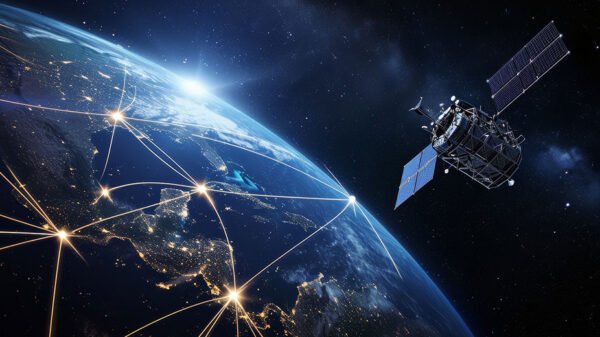





























Growing GPS jamming and spoofing are pushing researchers and technology companies to develop alternative navigation systems that could keep aircraft, ships and critical infrastructure operating when satellite signals are unavailable.
A report from the Center for a New American Security (CNAS) warns that GPS remains vulnerable because it depends on relatively weak signals transmitted from satellites. Those signals can be disrupted through jamming, spoofing or attacks on the satellites themselves.
“GPS interference already undermines military operations and disrupts up to thousands of commercial flights daily,” the report, written by CNAS Fellow Constanza M. Vidal Bustamante, noted.
The problem has become especially serious in maritime environments. Maritime intelligence company Windward recorded more than 18,300 vessels affected by GPS jamming globally during the second half of 2025.
During the first quarter of 2026, Windward recorded roughly 978,000 GPS jamming events worldwide, with 98 percent concentrated in the Middle East Gulf. More than 1,100 vessels in the region were affected.
Windward described the figure as the largest concentration of maritime GPS jamming it had recorded in a single quarter.
GPS has become so deeply integrated into modern infrastructure that its importance is often overlooked.
Transportation, emergency services, agriculture, logistics, communications, critical infrastructure and military operations all rely on satellite positioning and timing.
Shaun Moore, CEO and co-founder of Austin-based Tern, which develops non-GPS navigation systems, said GPS has effectively become an invisible foundation of the modern economy.
“GPS is not going away,” Moore told TechNewsWorld. “But something this critical cannot be a single point of dependency. We need independent ways to determine and maintain position.”
Michael Biercuk, CEO and founder of quantum-sensing company Q-CTRL, similarly described GPS as both ubiquitous and vulnerable.
The signals received from satellites are extremely weak, he said, making them relatively easy to disrupt either deliberately or in environments where satellite signals cannot reach, such as underwater.
One emerging alternative uses quantum sensors to measure tiny variations in Earth’s gravitational field.
Q-CTRL recently demonstrated its Ironstone Opal navigation system during a maritime trial in Australia’s Coral Sea. The company said the system achieved positioning accuracy of about one nautical mile without using GPS.
The technology, known as GravNav, detects subtle differences in Earth’s gravitational field — effectively creating a map of invisible gravitational hills and valleys. By comparing measurements against existing gravity maps, a navigation system can determine its location without receiving satellite signals.
Q-CTRL says the technology could eventually support navigation on land, at sea and in the air. It does not depend on external radio signals and can operate regardless of daylight or visibility conditions.
The CNAS report also identifies quantum sensors as a potentially important component of future positioning, navigation and timing systems.
Potential applications include submarines, drones and precision weapons, as well as timing infrastructure used by telecommunications networks, electricity grids and financial systems.
But the technology is still developing.
Quantum navigation systems must eventually become small, rugged and reliable enough to operate on moving vehicles and in demanding environments.
Gravity-based systems face a particularly difficult engineering problem: distinguishing Earth’s gravitational signal from the vibrations and acceleration generated by the vehicle carrying the sensor.
Sanket Deshpande, co-founder and CEO of quantum-navigation company Dirac Labs, said vibration isolation remains a major technical challenge.
The problem is further complicated by the size of some gravity-measuring quantum sensors. Certain systems can be as large as a small refrigerator and require sophisticated lasers and vacuum components.
Deshpande said magnetic navigation could have an advantage in terms of practical deployment.
Magnetic-field features can provide information similar to gravity maps, while quantum magnetic sensors are already considerably smaller and can be roughly the size of a golf ball.
Price is another major hurdle.
Traditional GPS receivers can cost only a few dollars, while advanced quantum sensors currently cost thousands of dollars.
Akshay Hanumegowda, CTO of freight-broker software company Loadguard, said early systems could cost between $10,000 and $20,000 per sensor.
Even if mass production eventually brings the price down to roughly $500 or $600, he said, conventional GPS would remain far cheaper for many commercial applications.
That could make the technology more attractive initially to military and other high-value applications where resilience is more important than equipment cost.
Allison Kealy, director of the Innovative Planet Institute at Swinburne University of Technology, said governments are increasingly interested in quantum sensing because of growing concerns about GPS disruption.
Although gravity sensors remain relatively large, she said researchers are working to reduce their size and move the technology out of laboratory environments.
The CNAS report also highlights a major funding imbalance within the broader quantum industry.
The United States attracts the largest share of private investment in quantum technology, but about 80 percent of that funding goes toward quantum computing. Only around 9 percent is directed toward quantum sensing.
CNAS argues that stronger government support will therefore be important to advance quantum positioning, navigation and timing technologies, particularly for defense applications.
The report also warns that China’s investment in quantum sensing is growing rapidly. Its state-backed approach, manufacturing capabilities and close integration between civilian and military research could allow it to make significant advances in the field.
GPS is unlikely to disappear. Instead, experts expect future navigation systems to combine multiple technologies so that a failure or attack on one system does not bring everything to a halt.
Deshpande expects governments and private investors to devote more resources to technologies such as magnetic navigation, particularly because they could enable navigation in environments such as underground and underwater locations where GPS is unavailable.
Biercuk said GPS will remain the primary navigation technology, but argued that resilient systems will increasingly depend on several independent sources.
“Quantum navigation can be an important part of that resilient navigation architecture,” he said, “and these technologies are increasingly being validated in real-world use cases.”
The broader goal is not necessarily to replace GPS, but to ensure that aircraft, ships, military systems and critical infrastructure can continue operating when satellite navigation is disrupted.