















Microsoft and Nvidia have unveiled the Surface Laptop Ultra, a new AI-focused laptop powered by Nvidia’s RTX Spark technology, alongside a series of Windows 11 updates designed to make AI agents more useful in everyday computing.
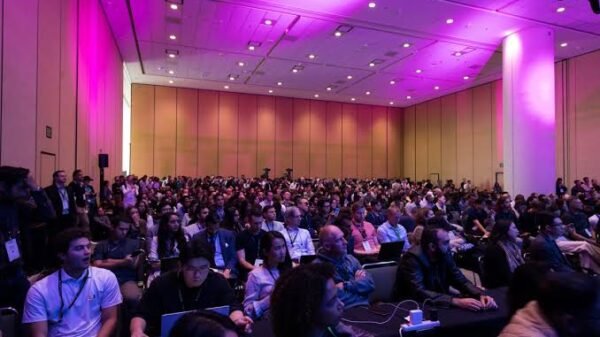
Announced at an event in San Francisco, the new device highlights Microsoft’s push toward a future in which AI assistants can interact with files, applications, and system settings while balancing processing between local hardware and cloud-based models.
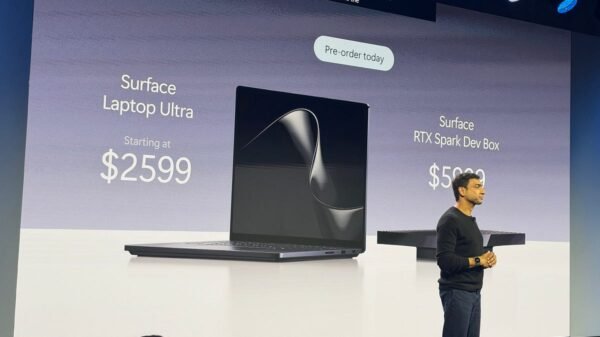
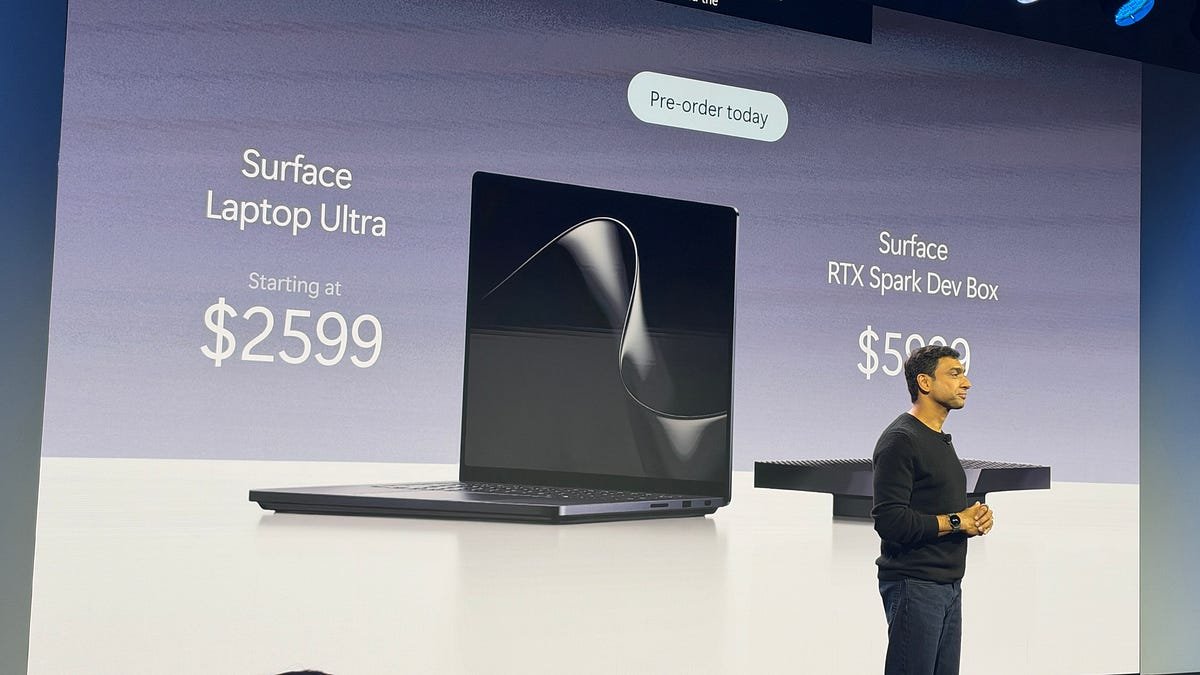
The Surface Laptop Ultra starts at $2,599, while the Surface RTX Spark Dev Box begins at $5,999. Both devices are available for pre-order, with shipping scheduled to begin October 16. Additional RTX Spark-powered systems from manufacturers including Asus, Dell, Lenovo, HP, and MSI are also expected to arrive around the same time.
Microsoft CEO Satya Nadella, Nvidia CEO Jensen Huang, and Windows and Devices chief Pavan Davuluri presented the new hardware and software capabilities during the event.
Huang described the launch as a fundamental reinvention of the personal computer, while Nadella framed the announcement around Microsoft’s broader AI ecosystem, including Agent 365, Microsoft IQ, and Copilot.
Surface Laptop Ultra Combines AI Performance With Gaming
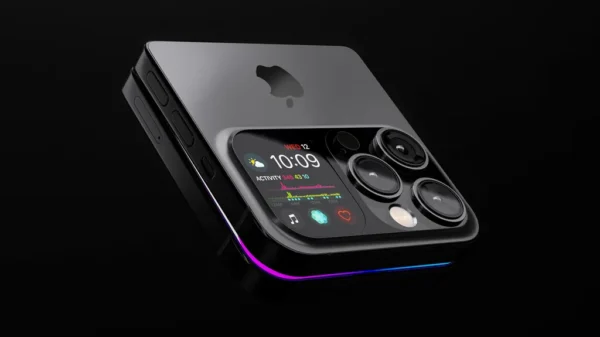
The Surface Laptop Ultra weighs approximately 4.5 pounds and features what Microsoft described as the brightest peak HDR display available on a laptop. The system also introduces a magnetic USB-C charging connection called Magnetic Connect, offering a MagSafe-like experience while using a standardized USB-C port.
During the presentation, Davuluri demonstrated the laptop running GitHub Copilot and playing Gears of War: E-Day at 60 frames per second. Microsoft also highlighted compatibility with hundreds of major releases and independent games at launch, with Call of Duty expected to arrive on RTX Spark in 2027.
The event included demonstrations involving Blender, Photoshop, ComfyUI, and Unreal Engine, showing how combinations of local and cloud AI models could accelerate complex creative workflows. Although the demonstration illustrated the potential time savings, it was a highly produced showcase rather than an independent performance evaluation.
Microsoft also compared RTX Spark with Apple’s M5 Pro-powered MacBook Pro, claiming up to 2.1 times faster time to first token, 4.3 times faster image generation, and 6.2 times faster video generation. These figures represent Microsoft’s stated comparisons and were not presented as independent benchmark results.
Windows 11 Introduces More Capable AI Agents
Alongside the hardware, Microsoft outlined changes to Windows 11 that will bring AI functions closer to everyday system controls.
New quick actions in the taskbar’s Search menu will allow users to adjust settings, capture screenshots, and organize windows using natural-language instructions. The interface will also direct users to Copilot when a request requires its assistance, allowing them to move between Windows Search and the AI assistant more seamlessly.
Microsoft demonstrated support for third-party AI models and tools, including Hermes, OpenClaw, and Perplexity. The company also said Meta’s Muse would be coming to Windows and announced a simplified setup process intended to make AI agents easier to configure.
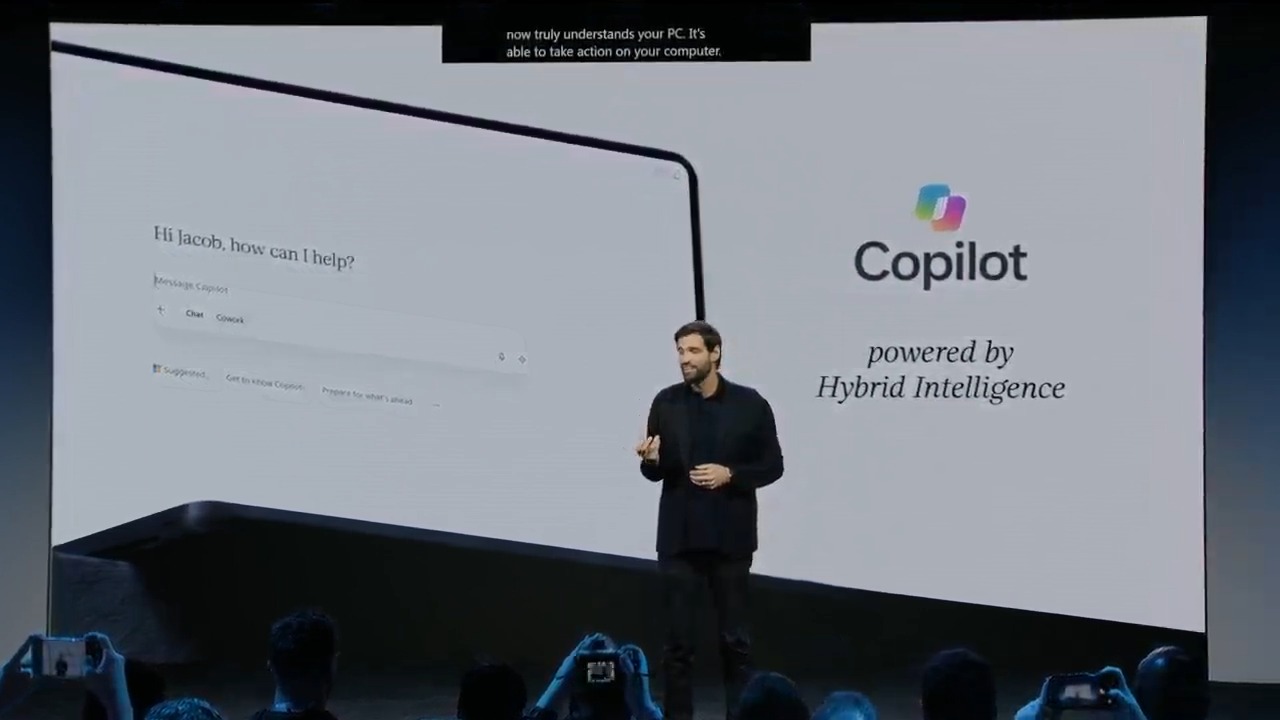
Copilot is also gaining the ability to work with local files and models, while continuing to use cloud-based AI when appropriate. Microsoft says the assistant will be able to choose between local and cloud processing depending on the task and privacy requirements.
In one demonstration, Copilot searched for tax documents, renamed files, compressed them into a folder, and drafted an email to an accountant. The user reviewed and approved the email before it could be sent. Microsoft said these capabilities would roll out over the following months.
(Image credit: Microsoft)
Microsoft Strengthens Controls for AI Agents
As AI agents gain access to files and applications, Microsoft is introducing additional safeguards designed to manage what they can access and which actions they can perform.
Davuluri highlighted Microsoft Execution Containers, which are integrated operating-system sandboxes designed to control the information available to AI agents. The technology is moving toward general availability.
Windows will also require agents to identify themselves when carrying out actions. For enterprise customers, Microsoft plans to provide centralized controls that allow IT administrators to establish rules for AI agents across an organization’s devices.
During a demonstration, Microsoft’s Divya Venkataramu showed how a user could retain access to documents that AI agents were not permitted to view, illustrating the distinction between human permissions and agent access.
These controls are intended to make AI-assisted workflows more practical without giving automated systems unrestricted access to sensitive information.
Hybrid Intelligence Combines Local and Cloud Models
(Image credit: Microsoft)
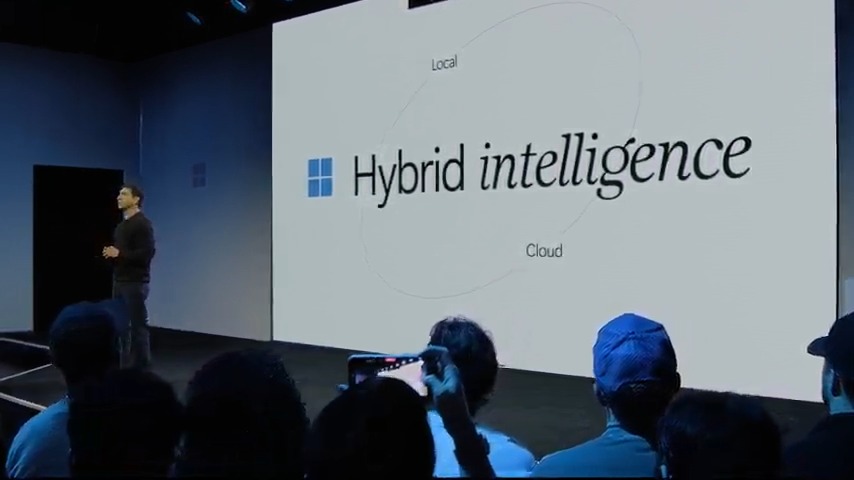
Microsoft is also promoting what it calls hybrid intelligence: a system that combines AI models running directly on a computer with cloud-based models to balance performance, privacy, and computing costs.
As part of this strategy, Microsoft’s HydraFusion technology is scheduled to arrive on Windows through GitHub on October 15. It will support GitHub Copilot, the command-line interface, and Visual Studio Code, using models including MAI Code 1.1 Flash and Nvidia’s Nemotron.
Davuluri also discussed running DeepSeek V4 Flash locally through advanced quantization at 1.6 bits, with approximately 60GB of memory. Quantization reduces the precision used to represent a model’s parameters, potentially lowering memory requirements and making local execution more practical.
Windows ML will serve as the runtime for deploying AI models across CPUs, GPUs, and neural processing units. Support for llama.cpp is also planned, giving developers another way to experiment with and run models on Windows hardware.
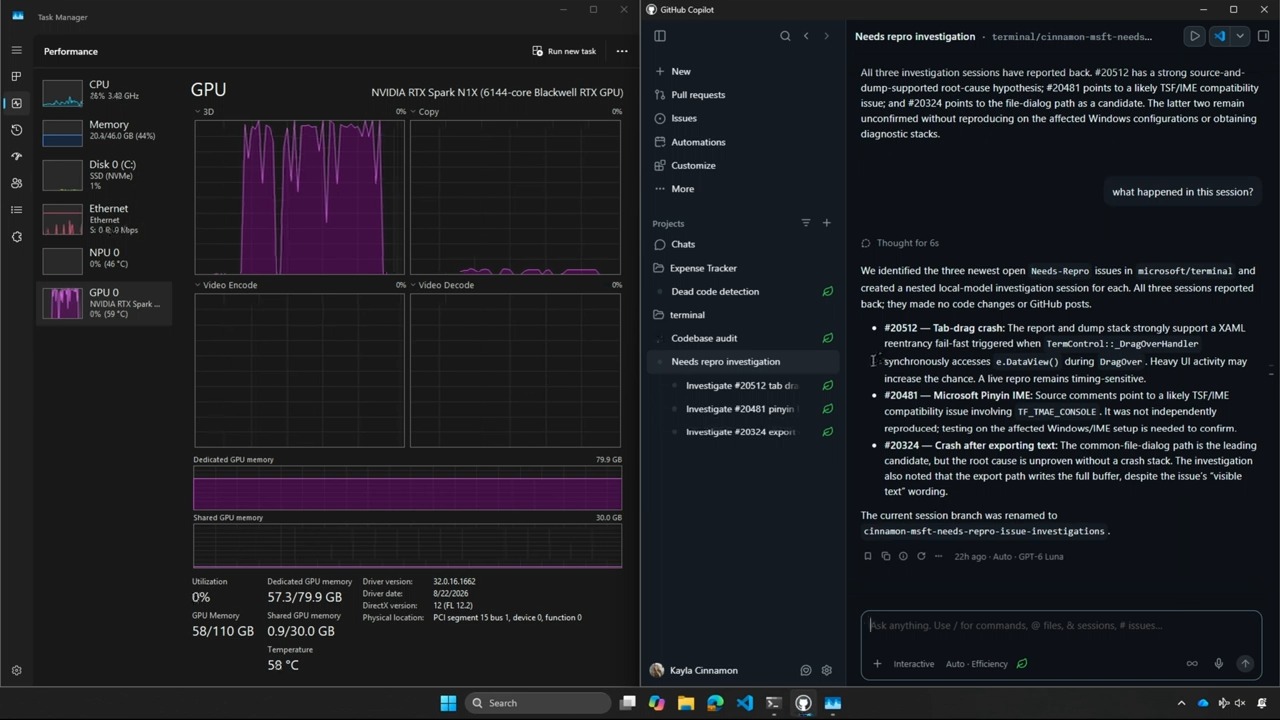
In a separate demonstration, Microsoft’s Kayla Cinnamon showed GitHub Copilot identifying unused code, packages, and feature flags in a software project. An Efficiency mode will allow Copilot to select models automatically according to task complexity, with more demanding work assigned to more capable models and supporting sub-agents running locally.
(Image credit: Microsoft)
Nvidia Expands Its Desktop AI Ecosystem
Microsoft also announced Windows support for Nvidia’s DGX Spark and DGX Station systems, which were previously focused on Linux. The machines are designed to bring substantial AI computing capabilities to desktop environments.
HP and Dell systems featuring the technology were shown during the event, with availability expected later in the year.
Together, the announcements point to Microsoft’s broader strategy of integrating AI agents into Windows while expanding the range of hardware capable of running AI workloads locally.
The Surface Laptop Ultra’s starting price of $2,599 places it firmly in the premium laptop category. Its appeal will depend on whether the combination of gaming, creative performance, and increasingly autonomous AI tools delivers enough practical value to justify the cost.
For Microsoft and Nvidia, the launch represents more than a new laptop. It is an effort to establish a computing ecosystem in which AI agents can operate across applications, devices, and cloud services while remaining subject to security and access controls.