




















The Apple iPod is now remembered as one of the most influential consumer technology products ever made. However, when Steve Jobs unveiled the first model on October 23, 2001, reactions were mixed. Some observers recognized its potential immediately, while others questioned why Apple was selling an expensive music player when many consumers were perfectly happy with their CD collections.
Twenty-five years after its debut, the original iPod remains a landmark in Apple’s history. Its promise of carrying “1,000 songs in your pocket” helped change how people stored, organized, and listened to music.
A Thousand Songs in Your Pocket
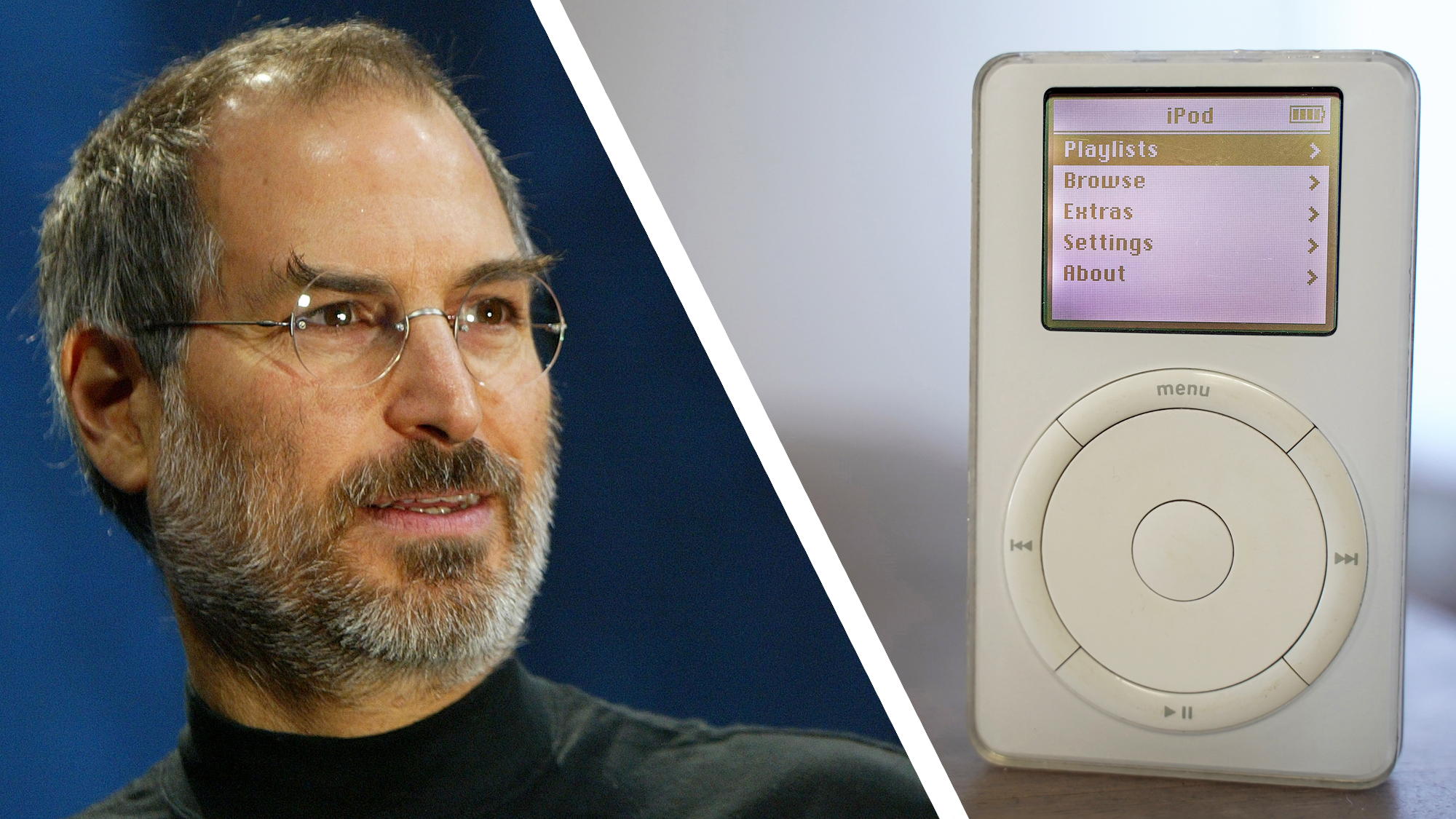
Steve Jobs introduced the first iPod at Apple’s Town Hall auditorium on the company’s Infinite Loop campus in Cupertino, California. He described it as a “breakthrough digital device” designed to make digital music more accessible.
The device cost $399 in the United States and £349 in the United Kingdom. At the time, Apple was best known for its computers, and the iPod represented a significant step into the consumer electronics market.
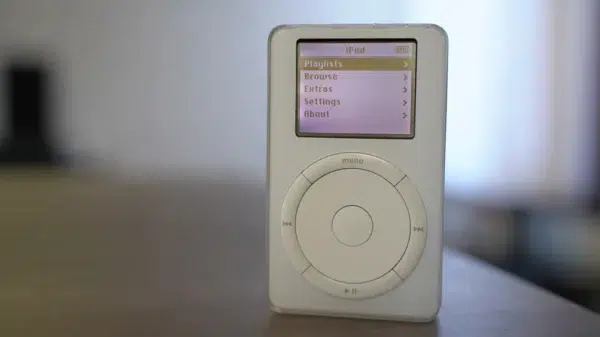
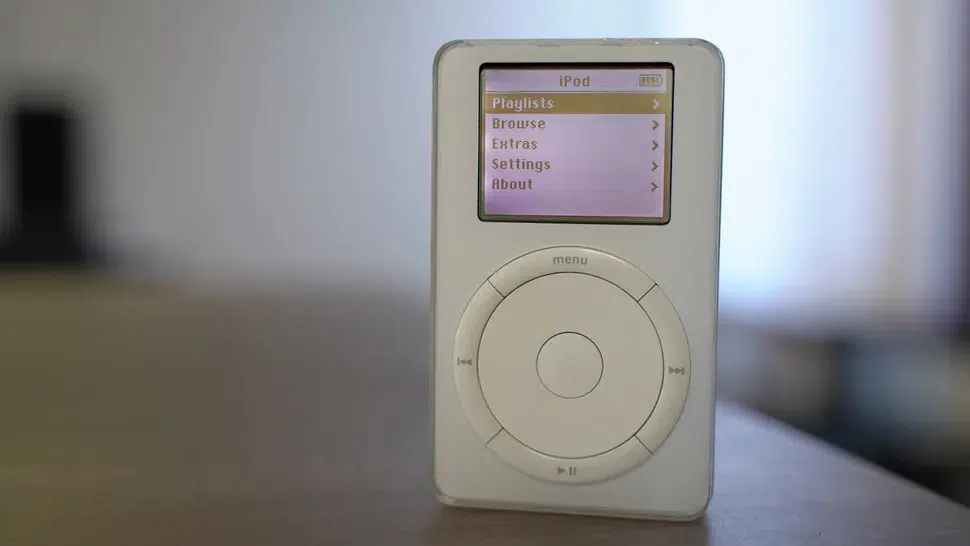
During the launch presentation, Jobs pulled the compact music player from his jeans pocket to demonstrate its portability. Its combination of 5GB of storage, a distinctive scroll wheel, and straightforward integration with iTunes on a Mac offered a compelling alternative to existing portable music players.
Although MP3 players had been available for several years, they remained relatively niche products. Digital music was still gaining mainstream acceptance, CD ripping was a comparatively unfamiliar practice, and many people obtained MP3 files through online piracy. Napster had shut down earlier in 2001, although other file-sharing services continued to emerge.
Apple’s new device, supported by iTunes, would become one of the key drivers of the digital music revolution.
What Made the Original iPod Different?
At the time, competing MP3 players tended to make compromises. Some offered comparable storage but were bulkier, while smaller devices often provided significantly less space.
The iPod found a balance between capacity and portability, aided by a new hard drive from Toshiba. Its scroll wheel also made navigating a library of thousands of songs more convenient, while its battery offered up to 10 hours of listening time.
Apple went to considerable lengths to help journalists understand the device’s capacity. During the launch, the company presented a cube made from taped-together CD jewel cases to represent the music stored on the iPod.
The demonstration illustrated the difference between carrying a collection of physical albums and keeping an extensive music library in a pocket-sized device.
Today, people can even experience a version of the original interface through a fully functional iPod Easter egg hidden on Apple Music’s page-not-found screen.
“It Was a Mixed Reaction”
Jason Snell, former editor of Macworld and host of the Designed in California podcast, attended the original launch. He remembers that some members of the press struggled to understand why Apple was introducing a product that wasn’t a Mac.
“It was a mixed reaction,” Snell recalled. “The price of $399 was considered to be high, despite the value of being able to fit a thousand songs in your pocket… I think most people just didn’t understand what the iPod was. MP3s were only beginning to rise in the public consciousness… Apple actually gave journalists a taped-together cube of CD jewel boxes representing the music it had preloaded on the first iPod.”
Snell, however, quickly understood the device’s appeal. His existing MP3 player could hold just eight songs, making the iPod’s capacity a dramatic improvement.
“I realized that the music collection on my work computer was only about 3GB in size,” he explained. “So I could fit every MP3 I’d ever made onto this thing with room to spare, and take it with me on my commute and listen to it as I rode the bus.”
For someone who already had a substantial digital music collection, the iPod offered an immediate and practical benefit.
Critics Called It a “Glorified Consumer Gimmick”
The skepticism surrounding the iPod was evident in an original MacRumors discussion thread posted on October 23, 2001. Some Apple enthusiasts had expected a new Mac computer and were unimpressed by the announcement of a music player.
Comments described the device as overpriced, a “glorified consumer gimmick,” and even “stupid.” One user simply asked, “Why would they do this?”
There were positive reactions, too. Some commenters thought the iPod looked impressive, while others recognized that it could represent the beginning of a much larger shift in portable music technology.
Nevertheless, the price was a significant obstacle. Many consumers already owned CD players and had little incentive to spend nearly $400 on a new device, especially when digital music had yet to become a mainstream habit.
The lack of Windows compatibility also limited the iPod’s immediate appeal. At launch, the player worked with Macs, while iTunes for Windows would not arrive until 2003.
Early Reviews Recognized Its Potential
Despite the reservations, several prominent technology commentators recognized the iPod’s strengths.
The New York Times explored the potential of the emerging digital music player market while questioning how much influence Apple’s product could have without Windows support. Columnist David Pogue praised its compact size, 5GB capacity, and speedy FireWire connection.
Walt Mossberg of The Wall Street Journal was particularly enthusiastic, describing the iPod as “simply the best digital music player I’ve seen.”
He acknowledged that competing products could be cheaper, smaller, or offer greater storage. However, he argued that Apple had succeeded in combining the most desirable features into a single device with an exceptional level of refinement and appeal.
The response from What Hi-Fi? was also favorable. The publication awarded the original iPod four out of five stars, highlighting its sound quality, bright screen, compact dimensions, and easy-to-use software. The review also noted that Creative offered a competing player with 20GB of storage.
These early assessments captured the iPod’s central proposition: it wasn’t necessarily the cheapest or highest-capacity player available, but it delivered a particularly well-integrated user experience.
From Skepticism to a Lasting Legacy
For Snell, the iPod quickly became more than an interesting new gadget. Just a week after its launch, he used it to play music in a hospital delivery room while his wife gave birth to their daughter.
That personal memory reflects how the device could fit naturally into everyday life, bringing a user’s music collection into situations where carrying CDs would have been impractical.
Over time, the iPod helped establish digital music players as mainstream consumer products and contributed to Apple’s broader transformation into a major consumer electronics company.
Smartphones have since absorbed much of the portable music player’s role, combining music playback with communication, photography, and internet access. Apple no longer sells the iPod, but its influence remains visible in the company’s approach to hardware, software, and user experience.
The first iPod was not universally celebrated when it launched in 2001. Its price, limited compatibility, and unfamiliar concept initially left some observers unconvinced. Yet its combination of storage, portability, and ease of use helped reshape how people experienced music.
Twenty-five years later, its place in technology history is secure—and its story serves as a reminder that even transformative products can take time to win over the world.